Thursday, May 9, 2013

From the Jeep Blind


The orioles arrived earlier this week at the farm so I made 4 feeding stations for them with orange halves.
One is on an old post that in the past supported a bird house. The raccoons toyed with the house pulling part of it down and left it hanging upside down.  I too left it hanging upside down…until finding a perfect use for it as an orange holder.  I also pounded nails into the post as additional orange hangers.
One is on an existing wrought iron type trellis that holds hanging feeders. I used a padlock to hold one of the tube feeders to the trellis, as the raccoons would raid the feeder at night. The padlock did well to hold the top of the tube feeder on the trellis but the raccoons succeeded in pulling the tube itself down – leaving only the top securely attached to the trellis via padlock. So I turned it upside down, secured it with several long zip ties and skewered the orange halves.
The other orange station is in the middle of a double shepard’s hook holding feeding platforms. I attached an old large grill fork to the middle of it – tines up – and skewered fruit. On this one, I put a half mango on the bottom and an orange half on top – wanting to experiment with different fruits.  From what I have observed, the male orioles want nothing to do with the mango – but the female orioles have cleaned the mango out nicely.  I think I will next try a pomegranate. 
The last station is merely one nail in a tree trunk – at DBH height – with half an orange.
The feeding stations are quite active and daily the oranges are totally pecked clean.  Naturally I wanted to observe them at a closer distance – but no longer have any field blinds as they were all stolen about a year ago. So I decided to use my Jeep as a blind.  My thought was that a bright yellow Jeep looked probably less threatening than me trying to sneak up on them. 
So I positioned the Jeep near the stations and opened the windows for clear view. Also decided to sit in the back seat so I would be less obvious. So climbing in my back seat – having to push over my large plastic tote holding field gear and bubbles – being careful of my toes (only wearing toe socks) around the hand saw and clippers on the floor – cramming myself into a sliver of the back seat I pull the door shut – and realize I am too cramped to maneuver the camera so I try to open the door…and remember it is the door that doesn’t open from the inside.  Now I am squished and stuck in the back seat and try to crawl about for some space.  So from my Jeep blind I had an interesting couple of hours before crawling over the seat to open a working door.
many Harris sparrows - so beautiful and large


in come the Baltimore orioles to the orange trellis – note the inverted lid of a tube feeder holding the orange and, of course, can’t miss the zip ties

head first into the orange

Baltimore oriole on the orange post - note the upside down partial bird house

female daintily supping the orange at the shepard's hook station - note the mango half below the orange

then in comes an orchard oriole – sending the Baltimore flying


but the Baltimore stays gone not so long


And returns to take over the orange
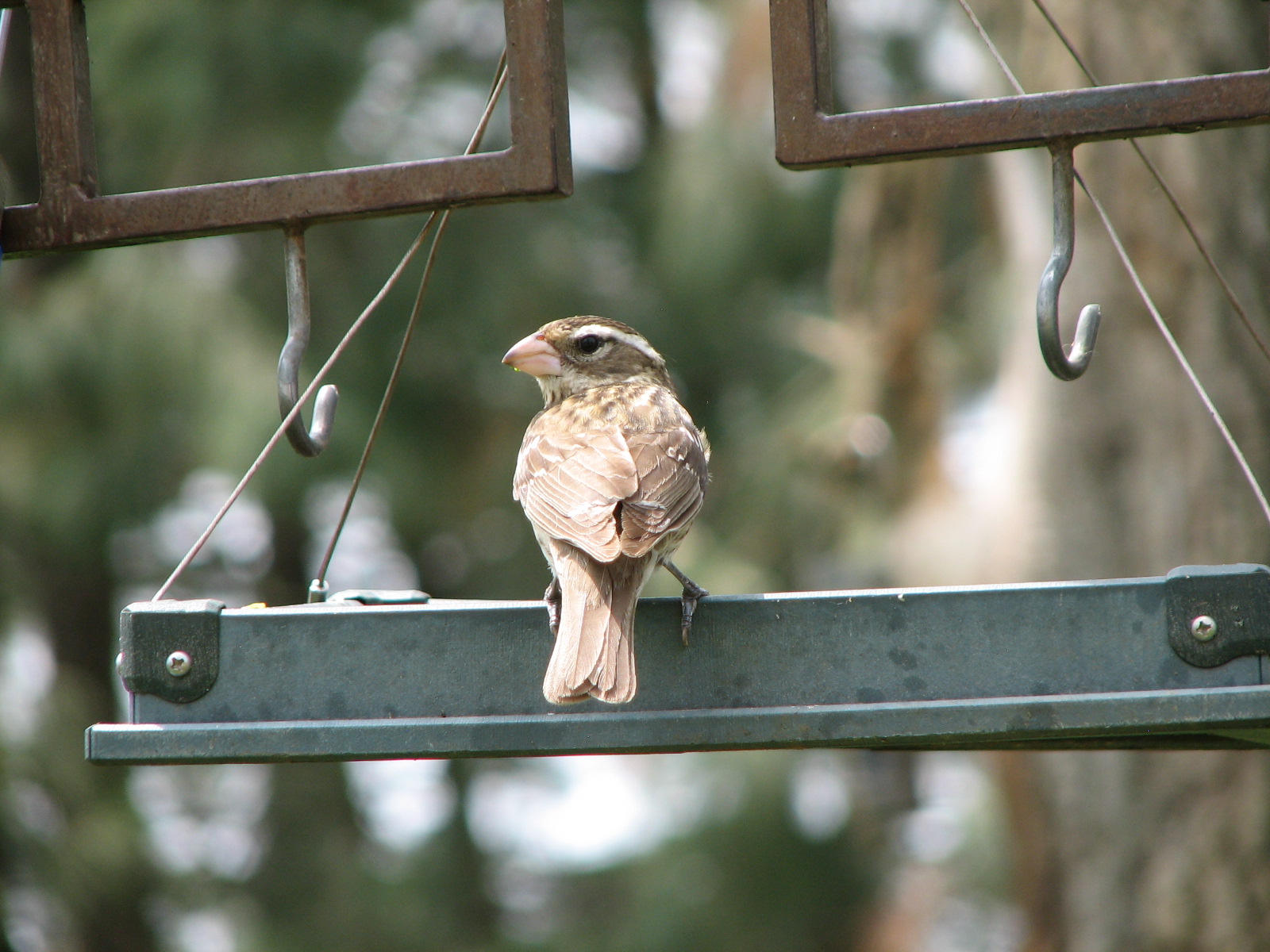
Then the grosbeaks begin their acts at the platform trellis feeder.


Then the males quickly attend – the first arrival (seemingly already familiar with this female) gets a place at the platform – the two interlopers sit atop the post and atop the trellis – but the familiar male quickly dismisses the intruders


Then another female arrives to gain attention


But the familiar male – who is obviously quite smitten with this first female – viciously does off with the flirty female


But wait – one of the interlopers is back!

BE DONE WITH YOU – AND NEVER RETURN!!!

He now turns to his beloved assuring his love


It was at this time that I realized while trying to jockey myself around in a cramped space – I kept hitting the camera settings – and thus reduced some clarity to blurry – the camera manual states I was in the “creative zone” for settings!
Thinking that only orioles are utilizing the oranges – I notice in the rear view mirror (remember I am lodged in the back seat) a grosbeak on the orange post – note the photo shows I am still in the creative zone.


However the grosbeak stayed only second and apparently did not savour the juice of the orange.
But then there was a big commotion and every one flew into the tree tops.  Looking around outside from my safe haven of the Jeep I notice…


Check out what is in the window…this is what I call the turkey vulture dance…


notice his dancing feet!


He then lofted away. And I emerged from the Jeep to stretch out my limbs and enjoy the rest of the birding day from a more comfortable distance.

Always and ever keeping watch over the oranges

And that's the saga of the Jeep Blind...
Gnome-ever-interesting!!!

Thursday, April 18, 2013

EPHEMERAL ETHEREAL - the beauties of spring

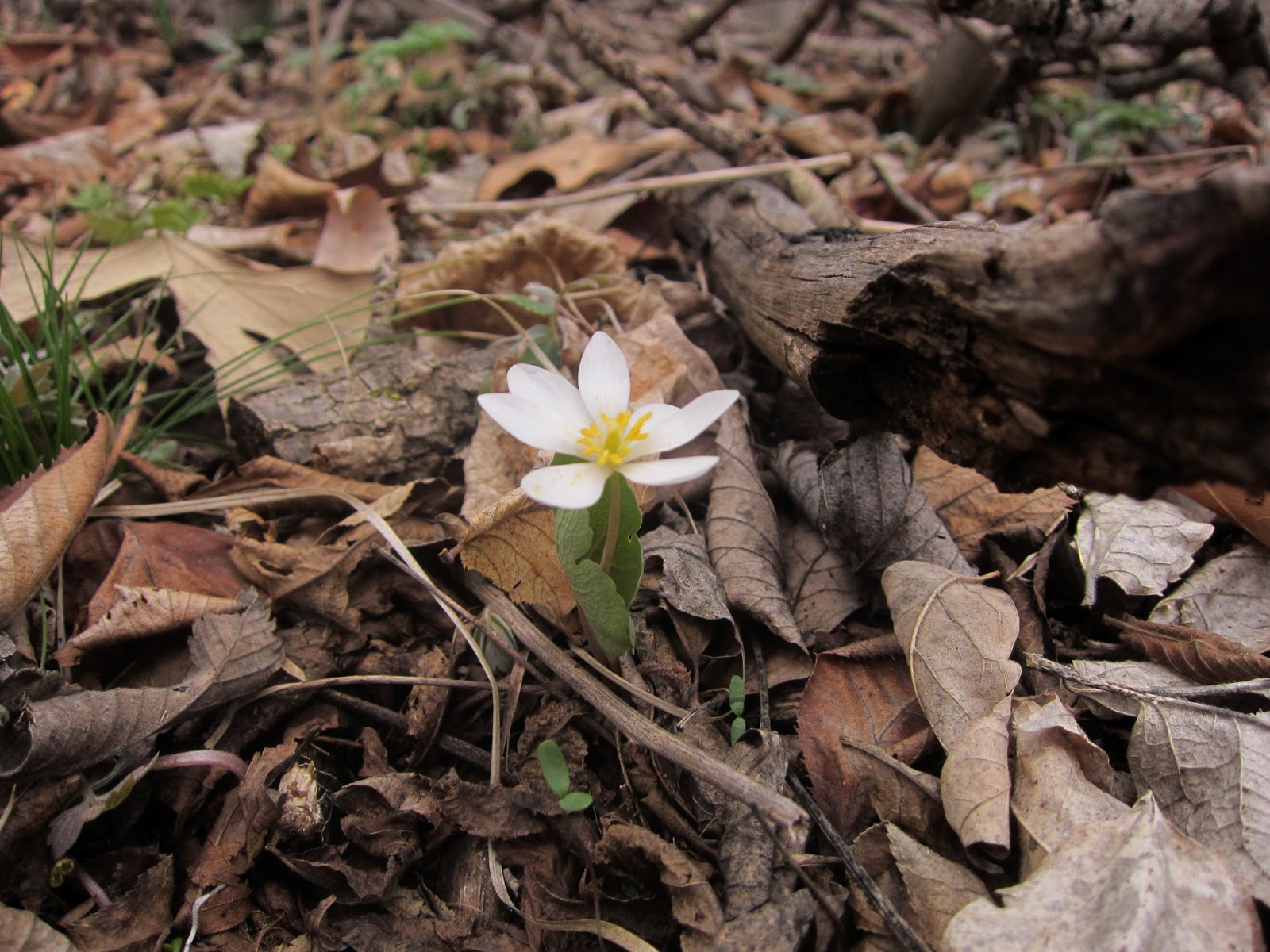
On Sunday past I had the pleasure of being one of a hiking duo in Neale Woods. Actually, my daughter was the "hiking" and I was the "huffing" part of the duo! I love both the ravines and the ridges of the woods - but on some days an escalator would be a nice advantage! Every hike reveals some special ordinary event and this did not disappoint. Upon close inspection, the ridge of Hilltop Trail merging into Maidenhair Trail was awash in Sanguinaria canadensis - aka - red puccoon - tetterwort - Bloodroot! Latin from sanguinarius - which means "bleeding."


The red-juiced herb cloaked in leaf as its tiny white blossom emerges - ever so cautiously unfolding to merge its yellow tuft with the woodland sunlight. It is one of the earliest spring bloomers and is oft familiar with a spring snow.


The flowers typically have 8 petals - alternating narrow and wide - exhibiting a square shaped visual.


bloodroot with waterleaf
Other than sumptuous deer food - it has been known to release a fine red dye when boiling the roots. The roots also contain the medical alkaloid sanguinarine. Decoctions were used for external treatment of skin disorders - and occasionally in small amounts internally for snakebites.

Melvin Gilmore interestingly noted its use as a love charm,

"For a love charm a bachelor of the Ponca, after rubbing some of the root on his palm, would contrive to shake hands with a girl he desired; if successful in this, after five or six days, she would be found willing to marry him. From this use comes the Omaha-Ponca name of the plant - Minigathe maka wau, 'woman-seeking medicine.' It was said to be used sometimes also as a decorative skin stain." Gilmore, Melvin R., "Uses of Plants by the Indians of the Missouri River Region," University of Nebraska Press, 1977.

I personally think the most successful - and possibly safest - use would be as a dye for cloth materials.

Also encountered a colony of Erythronium - fawn lilies - carpeting the woodland floor - camouflaged by their brown mottling of the leaves. These small bulbs are a favourite of small mammals - and of the human liking also. Gilmore said he was informed "by Winnebago that children ate them raw with avidity when freshly dug in springtime."


Other ephemeral encounters of the early spring hike include the miniature spring beauty, Claytonia virginica, and the distinctive baggy pants of the Dutchman's breeches, Dicentra cucullaria.


The Beauties were found in abundant patches across the steep hill slopes - unfortunately along with an abundance of garlic mustard as seen in the photo.

The spud-like flavour of the Spring beauties are a particular delicacy among the woodland Fairies, the best to harvest in the latest of March thru the earliest of June. Often the massive disappearance of the beauty spuds is attributed to deer preferences...hah!

On Dutchman's, it is the crouch of the breeches that attaches to the flower stalk - and the legs are filled with the luscious nectar. Noted by Ratzlaff and Barth in Field Guide to Wildflowers (FFNC and NWNC),

"The 'waist' is opened by early bumblebees. Their proboscises are long enough to reach the nectar in the spurs (legs), and to pollinate the flowers. Some bees, whose proboscises are too short, have learned to cut holes through the spurs to get to the nectar, then denying pollination of those plants."  I guess they need to more vigilant about who gets in their pants!!!

Others along the trail on a brisk Sunday...


The Trail less taken...


GNOMES RULES or The Rules of Gnomes
Rule 1 - Gnomes Rule
Rule 2 - Always follow Rule #1


Wednesday, April 17, 2013

SNIPPETS - Yard Yarns and Ordinary Days

Ordinary days are made up of snippets of ordinary time. And when you measure ordinary time individually, you find a subtle mosaic of chaos and order that reflects the balance of life - and of a day.

The yard at the farm offers wonderful opportunities to eyeball the community of residential fauna and avifauna. This past winter a quail honoured us with a snowy stay for a while...


And the resident skunk, with den hole beneath the pile of branches at the perimeter of the yard, appreciates the bounty under the bird feeders...


watch the tail...


the chickadee - caught in a stalled moment of usually cheeky effervescence...


chickadee splitting a seed in a heavy wind 


the deconstruction of the barn even spurred the Hawk to help...


the ritual emptying of the Sherman traps holding misplaced raptor delicacies...


but Spring is upon all and the "blue heads" are trotting...


and the red-wings are flocking...


the finches are golding...their gatherings look like swarms of lemon drops with wings...


and the bird bath becomes the "water cooler" of the yard with random robin gatherings...and apparently with one Angry Bird...


nuthatches are daily attendees - flying in near the top of the tree - and spiraling their way down the tree head first toward the feeder...I love the black and grey...


woodpecker watching - this Downy woodpecker flew to the pillar and then just sat there - not moving at all for about ten minutes - I think he was napping - he then jumped up to the water for a quick sip and then away...


and these Downy 'peckers are pairing - the Downy on the right kept dogging the other - following up and down branches and tree to tree - and he kept chattering at her...


wonderful pattern of the American Tree Sparrows...


and blending camouflage of the Flicker...


daily bark investigations...these by red bellied woodpecker and downy 'pecker...notice balancing with feathers...


and a few days past brings a recent arrival of the wood thrush...


for some reason he cocked his head to pick up seeds - look like the junco in the corner finds this curious behaviour also...


a couple "here's looking at you" birds...red-bellied and female robin...


Ordinary - defined as "with no special or distinctive features" - I take deliberate issue with that definition!  Take full measure...of the ordinary!


AN EXPERIMENT OF PICKY EATERS:

I found a pomegranate in the bottom of my back pack.  Having been there an unknown amount of time, the tough outer skin was now exceptional tough. So I decided to "plant" it in the hill garden of the farm yard. The next day something/one had dug it up and left it next to the hole, apparently not being able to bite through the tough skin or just not wanting to. So I "replanted" it in the same hole only this time piercing the skin with the edge of my spade. The next day again something/one had dug it up...this time though having relished the gelatinous fleshy seeds.


I then decided to venture into other fruits and "planted" a very ripe avocado...this was devoured by licking out the flesh around the seed without removing it from the planting hole...


I then "planted" a ripe mango...this was the limit...it was dug up and "thrown" into the yard without being eaten.  A few bite marks showed a tasting but not an eating. So mango must be the limit.

The "night of the avocado" we set up the wildlife camera and watched a raccoon and skunk come back and forth to the appetizer hole over the course of several hours.  The next day when I pulled in to the farm a group of turkey vultures were feasting on something in the south pasture.  My approach forced them to the air and nearby tree.


  Going over to investigate...


I found a skunk! Now one has to ask the question...was the combination of pomegranate one night followed by avocado the next too much for the skunk...causing him to stagger into the pasture and keel over? Or is this just the food chain of how turkey vultures get to pomegranates and avocados?


HOW ABOUT A NUMBERS GAME:
1-pick a number between 1 and 10
2-double it
3-add 10
4-divide in half
5-subtract the original number
6-the answer is 5

PONDER THIS:
It takes approximately 10,000 hours to perfect a skill.

LASTLY
Gnomes Rule and they will ALWAYS Rule